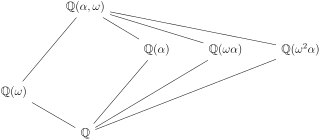
By using the fundamental theorem of Galois theory, the subfields of \(K/\Q\) corresponds precisely to the fixed fields of subgroups of \(\Gal{K}{\Q}\text{.}\) Note that following are all the subgroups of \(\Gal{K}{\Q}\text{.}\)
\begin{equation*}
H_0=\{e\}, H_1=\{e,\sigma,\sigma^2\}, H_2=\{e,\tau\}, H_3=\{e,\tau\sigma\}, H_4=\{e,\tau\sigma^2\}, \text{ and }, H_5=S_3
\end{equation*}
We calculate the fixed of of \(H_1\text{.}\) It is enough to find \(x\in K\) such that \(\sigma x=x\text{,}\) i.e., \((\sigma-\unit_K)(x)=x\text{.}\) We first find the matrix of \(\sigma\) with respect to a basis \(\mathfrak{B}=\{1,\alpha,\alpha^2,\omega,\omega\alpha,\omega\alpha^2\}\text{.}\) We get the following using \(\omega^2+\omega+1=0\in K\text{.}\)
\begin{align*}
[\sigma]_{\mathfrak{B}}-I_6\amp =\begin{pmatrix}1\amp 0\amp 0\amp 0\amp 0\amp 0\\0\amp 0\amp 0\amp 0\amp -1\amp 0\\0\amp 0\amp -1\amp 0\amp 0\amp 1\\0\amp 0\amp 0\amp 1\amp 0\amp 0\\0\amp 1\amp 0\amp 0\amp -1\amp 0\\0\amp 0\amp -1\amp 0\amp 0\amp 0\end{pmatrix}-\begin{pmatrix}1\amp 0\amp 0\amp 0\amp 0\amp 0\\0\amp 1\amp 0\amp 0\amp 0\amp 0\\0\amp 0\amp 1\amp 0\amp 0\amp 0\\0\amp 0\amp 0\amp 1\amp 0\amp 0\\0\amp 0\amp 0\amp 0\amp 1\amp 0\\0\amp 0\amp 0\amp 0\amp 0\amp 1\end{pmatrix}\\
\amp =\begin{pmatrix}0\amp 0\amp 0\amp 0\amp 0\amp 0\\0\amp -1\amp 0\amp 0\amp -1\amp 0\\0\amp 0\amp -2\amp 0\amp 0\amp 1\\0\amp 0\amp 0\amp 0\amp 0\amp 0\\0\amp 1\amp 0\amp 0\amp -2\amp 0\\0\amp 0\amp -1\amp 0\amp 0\amp -1\end{pmatrix}
\end{align*}
The rank of the matrix \([\sigma]_{\mathfrak{B}}-I_6\) is \(4\text{,}\) and hence the nullity is \(2\text{.}\) Note that \(\{1,\omega\}\) is a basis of its kernel. In particular, \(\left[K^{H_1}:\Q\right]=2=\lvert S_3:H_1\rvert\) and hence, \(K^{H_1}=\Q(\omega)\text{.}\) Furthermore, \(H_1\) is the normal subgroup of \(S_3\text{.}\) The fundamental theorem of Galois theory asserts that \(K^{H_1}=\Q(\omega)\) is Galois. Indeed, \(\Q(\omega)\) is the splitting field of an irreducible separable polynomial \(x^2+x+1\) over \(\Q\text{.}\)
The matrix \([\tau]_{\mathfrak{B}}-I_6\) with respect to \(\mathfrak{B}\) is
\begin{equation*}
\begin{pmatrix}I_3\amp -I_3\\0_3\amp -2\cdot I_3\end{pmatrix},
\end{equation*}
where, \(0_3\) and \(I_3\) are \(3\times 3\) zero matrix and the identity matrix, respectively. The kernel of the associated linear transformation has dimension \(3\) and \(\{1,\alpha,\alpha^2\}\) may be considered as a basis. Thus, we get that \(K^{H_2}=\Q(\alpha)\text{.}\) Note that \(\left[K^{H_2}:\Q\right]=\lvert S_3:H_2\rvert\text{.}\)
Now we can find \(K^{H_5}\text{.}\) For any \(x\in K^{H_5}\) we must have \(x\in K^{H_1}\cap K^{H_2}\text{.}\) Therefore, there exists some \(a_1,a_2\in\Q\) and \(b_1,b_2,b_3\in\Q\) such that
\begin{equation*}
x=a_1\cdot 1+a_2\cdot\omega=b_1\cdot 1+b_2\cdot\alpha+b_3\cdot\alpha^2
\end{equation*}
Since \(1,\alpha,\alpha^2,\omega\) are linearly independent over \(\Q\) we must have \(x\in\Q\text{.}\) Thus, \(K^{H_1}\cap K^{H_2}=\Q\text{.}\) In particular, \(K^{H_5}=\Q\text{.}\)
The matrix of \([\tau\sigma]_{\mathfrak{B}}-I_6\) with respect to \(\mathfrak{B}\) is
\begin{equation*}
\begin{pmatrix}0\amp 0\amp 0\amp -1\amp 0\amp 0\\0\amp -2\amp 0\amp 0\amp 0\amp 0\\0\amp 0\amp -1\amp 0\amp 0\amp 1\\0\amp 0\amp 0\amp -2\amp 0\amp 0\\0\amp -1\amp 0\amp 0\amp 0\amp 0\\0\amp 0\amp 1\amp 0\amp 0\amp -1\end{pmatrix}.
\end{equation*}
The rank of the above matrix is \(3\text{.}\) Hence, the kernel of the linear transformation associated with the above matrix has dimension \(3\text{.}\) One may take \(\{1,\omega\alpha,\alpha^2+\omega\alpha^2\}\) as a basis of the kernel. We thus have \(\left[K^{H_3}:\Q\right]=3\text{.}\) As \(\omega\alpha\in K^{H_3}\text{,}\) so is \((\omega\alpha)^2=-(\alpha^2+\omega\alpha^2)\text{.}\) Furthermore, \(\Q\left(\omega\alpha\right)\simeq\Q[x]/(x^3-2)\text{,}\) and hence, \(\left[\Q\left(\omega\alpha\right):\Q\right]=3\text{.}\) Therefore, \(K^{H_3}=\Q\left(\omega\alpha\right)\text{.}\)
The matrix The matrix \([\tau\sigma^2]_{\mathfrak{B}}-I_6\) with respect to \(\mathfrak{B}\) is
\begin{equation*}
\begin{pmatrix}0\amp 0\amp 0\amp -1\amp 0\amp 0\\0\amp -1\amp 0\amp 0\amp 1\amp 0\\0\amp 0\amp -2\amp 0\amp 0\amp 0\\0\amp 0\amp 0\amp -2\amp 0\amp 0\\0\amp 1\amp 0\amp 0\amp -1\amp 0\\0\amp 0\amp -1\amp 0\amp 0\amp 0\end{pmatrix}.
\end{equation*}
The rank of the above matrix is \(3\text{.}\) Hence, the kernel of the linear transformation associated with the above matrix has dimension \(3\text{.}\) One may take \(\{1,\alpha+\omega\alpha,\omega\alpha^2\}\) as a basis of the kernel. We thus have \(\left[K^{H_4}:\Q\right]=3\text{.}\) Note that \(-(\alpha+\omega\alpha)=\omega^2\alpha\text{.}\) Thus, \(\omega^2\alpha\in K^{H_4}\text{.}\) Furthermore, \(\Q\left(\omega^2\alpha\right)\simeq\Q[x]/(x^3-2)\text{,}\) and hence, \(\left[\Q\left(\omega^2\alpha\right):\Q\right]=3\text{.}\) Therefore, \(K^{H_4}=\Q\left(\omega^2\alpha\right)\text{.}\)