Section A Galois subfield of the rational functional field
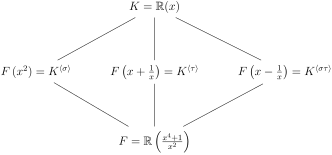
We consider another example of a Galois extension of fields. Let \(K=\R(x)\) the rational function field over \(\R\) and let \(F=\R\left(\tfrac{x^4+1}{x^2}\right)\text{.}\) We show that \(K/F\) is a Galois field extension with Galois group isomorphic to the Klein four-group \(V_4\text{.}\)
First note that \(x^4+1\) and \(x^2\) are coprime polynomials in \(\R[x]\text{.}\) Thus, by Exercise 7
https://suohyd.github.io/Algebra-III/worksheets/activity-tutorial-3.html, we have the following.-
The polynomial \(f(s)=\left(s^4+1\right)-\tfrac{x^4+1}{x^2}s^2\in F[s]\) is irreducible over \(F\text{,}\) and \(x\in\R(x)\) is a root of \(f(s)\text{.}\) Therefore, \(f(s)\) is the minimal polynomial of \(x\) over \(F\text{.}\)
We have the following four distinct \(F\)-automorphisms of \(K\text{.}\)
\begin{equation*}
\unit_{K};\quad \sigma(x)=-x;\quad \tau(x)=\tfrac{1}{x};\quad \sigma\tau(x)=\tau\sigma(x)=-\tfrac{1}{x}.
\end{equation*}
The order of \(\sigma\) and \(\tau\) is \(2\text{.}\) Furthermore, we also have \(\lvert\Aut{K}{F}\rvert\leq [K:F]=4\) (see Corollary 10, Chapter 14, Dummit and Foote). Hence, \(\lvert\Aut{K}{F}\rvert = [K:F]=4\) and hence, \(K/F\) is Galois. This shows that \(K^{\Aut{K}{F}}=F\text{.}\) We now verify this directly.
We take \(\mathfrak{B}=\{1,x,x^2,x^3\}\) as an \(F\)-basis of \(K\text{.}\) For brevity we put \(t=\tfrac{x^4+1}{x^2}\text{.}\) We use the relation \(x^4-tx^2+1=0\) to compute the matrix representations of the automorphisms with respect to the basis \(\mathfrak{B}\text{.}\)
\begin{equation*}
[\unit_{K}]_{\mathfrak{B}}=\begin{pmatrix}
1 \amp 0 \amp 0 \amp 0 \\
0 \amp 1 \amp 0 \amp 0 \\
0 \amp 0 \amp 1 \amp 0 \\
0 \amp 0 \amp 0 \amp 1
\end{pmatrix};\quad [\sigma]_{\mathfrak{B}}=\begin{pmatrix}
1 \amp 0 \amp 0 \amp 0 \\
0 \amp -1 \amp 0 \amp 0 \\
0 \amp 0 \amp 1 \amp 0 \\
0 \amp 0 \amp 0 \amp -1
\end{pmatrix};\quad [\tau]_{\mathfrak{B}}=\begin{pmatrix}
1 \amp 0 \amp t \amp 0 \\
0 \amp t \amp 0 \amp t^2-1 \\
0 \amp 0 \amp -1 \amp 0 \\
0 \amp -1 \amp 0 \amp -t
\end{pmatrix};\quad [\sigma\tau]_{\mathfrak{B}}=\begin{pmatrix}
1 \amp 0 \amp t \amp 0 \\
0 \amp -t \amp 0 \amp 1-t^2 \\
0 \amp 0 \amp -1 \amp 0 \\
0 \amp 1 \amp 0 \amp t
\end{pmatrix}
\end{equation*}
The kernel of the linear transformation associated to \([\sigma]_{\mathfrak{B}}-I_4\) (resp., \([\tau]_{\mathfrak{B}}-I_4\)) has \(\{1,x^2\}\) (resp., \(\{1,(1+t)x-x^3\}\)) as an \(F\)-basis. Therefore, \(K^{\Aut{K}{F}}=F\text{.}\)