
Section Field extensions

Proof.

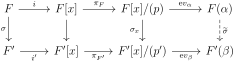
Note that \(p'\) is also irreducible. Indeed, \(\sigma\) induces an isomorphism of rings \(F[x]\simeq F'[x]\) by defining \(\sum a_ix^i\mapsto\sum\sigma(a_i)x^i\text{.}\) Furthermore, this isomorphism induces an isomorphism of \(F[x]/(p)\xrightarrow{\sigma_x} F'[x]/(p')\) given by \(\sum a_ix^i+(p)\mapsto \sum\sigma(a_i)x^i+(p')\text{.}\) In the following diagram, we can consider the isomorphism \(\widetilde{\sigma}=\ev_\beta\circ\sigma_x\circ{\ev_\alpha}^{-1}\text{.}\)
Figure 29.

Example 30. Degree of a tower of field extensions.

Suppose that \(\alpha=\sqrt[3]{2}\in\R\) and \(\beta=\omega\alpha\in\C\text{,}\) where \(\omega\) is a primitive cube root of unity. Suppose that \(K=\Q(\alpha)\) and that \(L=K(\beta)\text{.}\) We show that \([L:\Q]=6\text{.}\)
First of all note that \(\beta\not\in\R\) and hence \(\beta\not\in K\text{.}\) Furthermore, \(x^3-2\) is the minimal polynomial of \(\alpha\) over \(\Q\) and hence \([K:\Q]=3\text{,}\) and \(\{1,\alpha,\alpha^2\}\) is a \(\Q\) basis of \(K\text{.}\) The minimal polynomial of \(\beta\) over \(K\) is \(x^2+\alpha x+\alpha^2\text{,}\) which is irreducible over \(K\) since it has no roots in \(K\text{.}\) Therefore, \([L:K]=2\text{,}\) and \(\{1,\beta\}\) is a \(K\) basis of \(L\text{.}\)
We claim that \(\{1,\alpha,\alpha^2,\beta,\alpha\beta,\alpha^2\beta\}\) is a \(\Q\) basis of \(L\text{.}\) Let \(x\in L\text{.}\) There exists a unique \(a_0,a_1\in K\) such that \(x=a_0+a_1\beta\text{.}\) Furthermore, there exists a unique \(b_{0i}\) and \(b_{1i}\text{,}\) for \(0\leq i\leq 2\) such that \(a_0=\sum_{i=0}^2b_{0i}\alpha^i\) and \(a_1=\sum_{i=0}^2b_{1i}\alpha^i\text{.}\) In particular, we can write \(x=\sum_{i=0}^2b_{0i}\alpha^i+\sum_{i=0}^2b_{1i}\alpha^i\beta\text{.}\) This shows that \(x\) can be expressed as a linear combination of the elements in \(\{1,\alpha,\alpha^2,\beta,\alpha\beta,\alpha^2\beta\}\text{.}\) Hence, this set spans \(L\) over \(\Q\text{.}\) To show that it is linearly independent, suppose that there are \(c_0,c_1,c_2,d_0,d_1,d_2\in\Q\) such that
\begin{equation*} \sum_{i=0}^2 c_i\alpha^i+\sum_{i=0}^2d_i\alpha^i\beta=0. \end{equation*}
As \(\{1,\beta\}\) is a basis of \(L\) over \(K\text{,}\) we get that
\begin{equation*} \sum_{i=0}^2 c_i\alpha^i=0\in K\quad\text{ and }\quad\sum_{i=0}^2d_i\alpha^i=0\in K. \end{equation*}
Using the fact that \(\{1,\alpha,\alpha^2\}\) is a basis of \(K\) over \(\Q\text{,}\) we get that \(c_i=0\) and \(d_i=0\) for all \(i\text{.}\) This shows that \([L:\Q]=6\text{.}\)
Proof.

Consider the following set.
\begin{equation*} S=\{(E,i_E):F\subseteq E\subseteq K\text{ and }i_E\colon E\hookrightarrow\overline{F}\text{ which is identity on }F\}\text{.} \end{equation*}
This is a nonempty set as \((F,i_F)\in S\text{,}\) where \(i_F\colon F\hookrightarrow\overline{F}\) is the inclusion map. We define a partial order on \(S\) by setting \((E,i_E)\leq (E',i_{E'})\) if \(E\subseteq E'\) and \(i_{E'}|_E=i_E\text{.}\) Suppose that \((E_i,i_{E_i})_{i\in I}\) is a chain in \(S\text{.}\) Then, \(E=\cup E_i\) is a field and we define \(i_E(x)=i_{E_k}(x)\) if \(x\in E_k\text{.}\) One may verify that \(i_E\) is a well-defined embedding which is identity on \(F\text{.}\) So, we can apply Zorn’s lemma to get a maximal element \((M,i_M)\in S\text{.}\) We claim that \(M=K\text{.}\) Indeed, if \(x\in K\) then, \(x\) is algebraic over \(M\text{.}\) Let \(m_{x,M}\) be the minimal polynomial of \(x\) over \(M\text{.}\) By using \(i_M\colon M\hookrightarrow\overline{F}\text{,}\) we may take \(\overline{F}\) as an algebraic closure of \(M\text{.}\) Suppose that \(\alpha\in\overline{F}\) is a root of \(m_{x,M}\text{.}\) Hence, there is an embedding \(M[t]/(m_{x,M})\hookrightarrow\overline{F}\) extending \(i_M\text{.}\) Since, \(M(x)\simeq M[t]/(m_{x,M})\text{,}\) we get an embedding \(i_{M(x)}\colon M(x)\hookrightarrow\overline{F}\text{.}\) By the maximality of \(M\) we conclude that \(M(x)=M\text{.}\) As \(x\in K\) was arbitrary, we get that \(M=K\text{.}\)

Proof.

The embedding \(i_K\colon K\to\overline{F}\) makes \(\overline{F}\) an algebraic closure of \(K\text{.}\) Therefore, we can apply PropositionΒ 31 with \(F\) replaced by \(K\) to get an embedding \(i_L\colon L\hookrightarrow\overline{F}\) which is the identity on \(K\text{.}\) In particular, it is the identity on \(F\text{.}\)

Proof.

We apply PropositionΒ 31 with \(K=\overline{F_1}\text{,}\) to get an embedding \(i\colon\overline{F_1}\hookrightarrow\overline{F_2}\) which is the identity on \(F\text{.}\) By the isomorphism theorem \(i(\overline{F_1})\simeq \overline{F_1}\text{,}\) and hence \(i(\overline{F_1})\) is algebraically closed. However, \(\overline{F_2}/i(\overline{F_1})\) is an algebraic extension. This shows that \(i(\overline{F_1})=\overline{F_2}\text{,}\) and hence \(i\colon\overline{F_1}\to\overline{F_2}\) is a required isomorphism.

Checkpoint 35.

Let \(E/K\) be an algebraic field extension and let \(K\) be algebraically closed field. Show that \(E=K\text{.}\)

